Home › GEO vs SEO vs AEO
Guide · updated November 2026GEO vs SEO vs AEO: what's the difference? (2026)
Three names for getting found. SEO is about Google's results. AEO is about being the direct answer. GEO is about being named inside AI answers from ChatGPT, Perplexity and Google. Here's what each one means, where they overlap, and what to actually do.
 By Basil Russo, Founder and Partner, Redline Toronto. Updated 18 November 2026.
Free and written. Within 1 business day. No call needed.
What's the difference between GEO, AEO and SEO?
SEO (search engine optimization) gets your pages ranked and clicked in search results. AEO (answer engine optimization) shapes your content so a search engine or assistant can lift a direct answer from it. GEO (generative engine optimization) is the work of getting your business named and cited inside AI-written answers in ChatGPT, Perplexity, Gemini and Google's AI Overviews. All three stand on the same foundation, and Google calls optimizing for its AI features "still SEO".
So you don't need three agencies or three strategies. You need one plan that gets your pages found, makes your answers easy to quote, and gets your business mentioned in the places AI tools read. Comparing agencies for it? Use our AI SEO agency checklist.
- Side by side
- Definitions
- What Google says
- Where GEO differs
- The click problem
- One plan
- How to measure
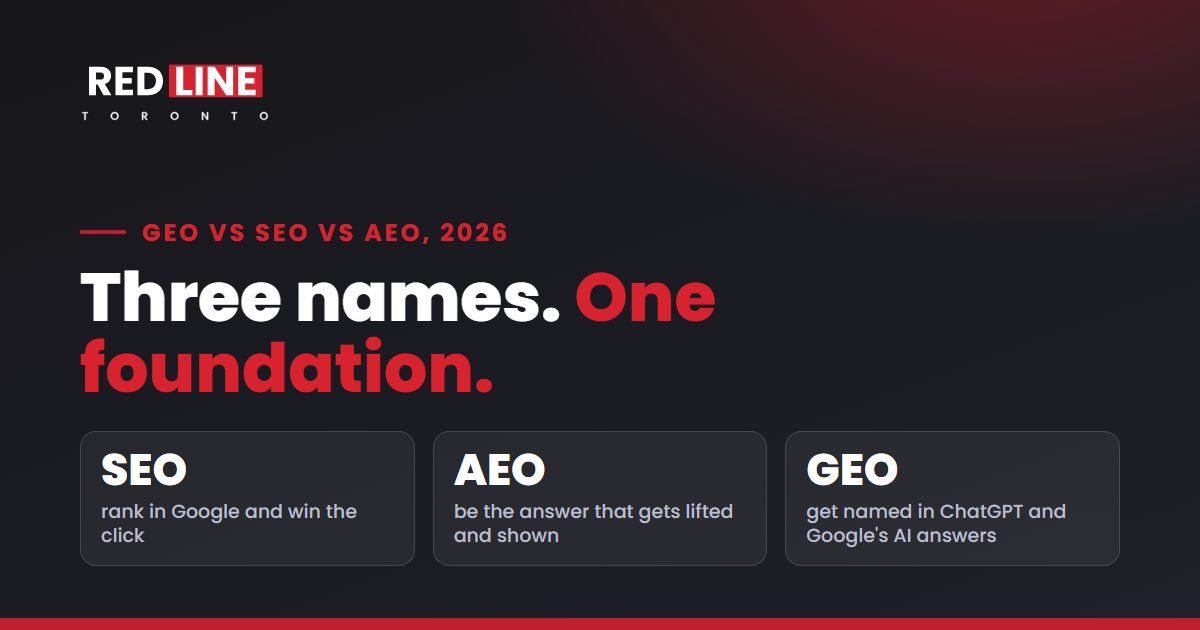
SEO vs AEO vs GEO, compared.
The same work shows up in three places. Here's how they differ.
| SEO | AEO | GEO | |
|---|---|---|---|
| Stands for | Search engine optimization | Answer engine optimization | Generative engine optimization |
| The goal | Rank in the results and win the click | Be the answer that gets lifted and shown directly | Be named, quoted or linked in an AI-written answer |
| Where it shows | Google and Bing results, Google Maps | Featured snippets, People Also Ask, voice answers | ChatGPT, Perplexity, Gemini, Copilot, Google's AI Overviews and AI Mode |
| What wins | Pages that fully answer the search, a crawlable site, links and reviews | Short, self-contained answers under clear question headings, tables and lists | Specific facts, the same facts everywhere, and mentions on sites AI tools trust |
| How it's measured | Rankings, clicks, calls and leads | How often your answer is the one shown | How often AI answers name you, how accurately, and the visits they send |
| Who controls it | Google and Bing's ranking systems | The search engine choosing a snippet | Each AI system, with its own crawler and sources |
- The work overlaps more than the names suggest. A page built to rank, answer and be quoted does all three jobs.
- The real differences are in measurement and in off-site mentions, covered below.
What SEO, AEO and GEO each mean.
SEO: be found and clicked
Search engine optimization is the work of getting your pages to rank in Google and Bing for the searches your customers use, then turning those visits into calls, bookings and sales. It covers three things: a site search engines can crawl and understand, pages that fully answer the searcher, and a reputation (links, reviews, mentions) that makes you the trusted choice.
For a local business, SEO also means your Google Business Profile and how you rank on Google Maps.
AEO: be the answer
Answer engine optimization shapes content so a machine can lift a clean, direct answer from it. The idea is older than ChatGPT: it grew out of featured snippets, People Also Ask boxes and voice assistants reading one answer aloud.
In practice, AEO is formatting with a purpose. A question as the heading. A two or three sentence answer right under it. Then the detail, a table or a list.
GEO: be named by AI
Generative engine optimization is about the answers AI systems write. Instead of ten links, ChatGPT, Perplexity or Google's AI Overviews write a response and cite a handful of sources. GEO is the work of being one of them, and of being described accurately.
The term comes from a 2023 research paper, "GEO: Generative Engine Optimization" (Aggarwal et al., arXiv, accepted to KDD 2024). On the authors' own benchmark of queries, the methods they tested raised a source's visibility in generative engine responses by up to 40%, and what worked varied by subject.
You'll also see LLM SEO, AI SEO and AI search optimization. They describe the same goal as GEO.
What Google says about GEO and AEO.
Google addressed the new labels directly in its guide to optimizing for generative AI search (Google Search Central, updated July 2026):
No, not for Google Search. Google says: "From Google Search's perspective, optimizing for generative AI search is optimizing for the search experience, and thus still SEO." Its AI Overviews and AI Mode are "rooted in our core Search ranking and quality systems", and it says "there are no additional requirements to appear in AI Overviews or AI Mode, nor other special optimizations necessary."
Google's AI features retrieve pages from its normal search index, then use a technique it calls "query fan-out": several related searches run at once to build one answer (AI features and your website). To be eligible as a supporting link, a page must be indexed and eligible to show with a snippet. That's the same bar as any search result.
The same guide lists things you can skip for Google Search:
- An llms.txt file or other "AI" markup. Google Search ignores them. They won't hurt, and other systems may read them.
- "Chunking" pages into tiny pieces. Google says there's no ideal page length.
- Rewriting copy just for AI. AI systems understand synonyms and meaning.
- Chasing inauthentic mentions. Google says it "isn't as helpful as it might seem": its AI features rely on the same systems that reward quality and block spam.
- Special schema. Structured data isn't required for AI features, though it still helps with rich results.
Where GEO is different from SEO.
Google's view covers Google. ChatGPT, Perplexity and Copilot are separate systems with their own crawlers and their own ways of picking sources. Three differences matter in practice.
1. Each AI tool needs its own access
ChatGPT search finds pages with OpenAI's own crawler, OAI-SearchBot. OpenAI says sites that block it "will not be shown in ChatGPT search answers, though can still appear as navigational links" (OpenAI). It's a separate setting from GPTBot, which collects training data. A firewall or CDN setting can block AI crawlers without anyone noticing, so check yours.
2. Mentions elsewhere count for a lot
AI answers lean on what other sites say about you: lists, reviews, directories, forums, news. In Ahrefs' study of 75,000 brands, mentions across the web correlated more strongly with appearing in AI Overviews (0.664) than Domain Rating (0.326) or backlinks (0.218) (Ahrefs). That's a correlation, not proof of cause. You can see the pattern yourself: ask an AI tool to recommend a business like yours and look at the sources it cites.
3. Ranking helps, but it isn't the whole picture
- 38%
of the pages cited in Google's AI Overviews also rank in Google's top 10 for that search.
Ahrefs · 863K results · Mar 2026 - 12%
of links cited by AI assistants rank in Google's top 10 for the same prompt, on average.
Ahrefs · 15K prompts · Aug 2025 - 25.7%
fresher: pages cited by AI assistants were newer, on average, than pages in organic results.
Ahrefs · 17M citations · Jul 2025
- Ranking in Google is still your main route into Google's AI answers.
- For ChatGPT and Perplexity, ranking isn't enough. You also need crawler access, current pages, and mentions on the sites those tools cite.
AI answers mean fewer clicks. Be the one that's cited.
When an AI summary appears, fewer people click through to websites. The businesses named in the summary still get seen, and still get chosen.
- No AI summary on the page15%
- AI summary on the page8%
- Clicked a link inside the AI summary1%
Source: Pew Research Center, 900 US adults, 68,879 searches, March 2025.
- 58% fewer clicks. Ahrefs estimates an AI Overview cuts the click rate of the top-ranked page by 58% (Ahrefs, February 2026).
- In Canada, most searches end without a click. SparkToro measured 63.8% of Google searches in Canada as zero-click. Only 268 of every 1,000 searches ended in a click to the open web (SparkToro, June 2026).
For the full picture, with every number checked at its source, see our SEO and AI search statistics for 2026.
One plan that covers SEO, AEO and GEO.
Here's the order we work in. Each step helps all three, and the label shows where it matters most.
- Let every search crawler in (SEO, GEO). Googlebot, Bingbot and the AI search crawlers such as OAI-SearchBot and PerplexityBot. Check your robots.txt and your firewall or CDN settings.
- Put the words in the HTML (SEO, GEO). Text that only appears after scripts run, or only inside images, is harder for crawlers to read.
- Answer first (AEO, GEO). Use the customer's question as the heading, then two or three plain sentences that answer it. Detail comes after.
- Show the comparison (AEO, GEO). Prices, timelines, options side by side in a real table. AI answers are often comparisons, and tables are easy to quote.
- Use one set of facts everywhere (GEO). Name, address, phone, services, prices and hours, identical on your site, your Google Business Profile and every listing.
- Get mentioned where AI tools look (GEO). Industry directories with real reviews, local best-of lists, associations and press. Earned, never bought.
- Keep key pages current (SEO, GEO). Update the numbers and dates on the pages that matter, and show when they were updated.
- Measure all three (SEO, AEO, GEO). Rankings and leads, the answers you win, and how often AI tools name you.
Each step is spelled out in our LLM SEO guide, and every check is in our SEO checklist for 2026. Want it done for you? See AI SEO for Toronto businesses.
How to measure SEO, AEO and GEO.
| What to track | Where to find it | Covers |
|---|---|---|
| Rankings, impressions and clicks from Google | Search Console's Performance report. Google counts AI Overviews and AI Mode in the "Web" search type. | SEO, GEO |
| How your pages do in Google's AI features | Search Console's Generative AI performance report (Google) | GEO |
| Visits from AI assistants | Google Analytics referrals from chatgpt.com, perplexity.ai, gemini.google.com and copilot.microsoft.com | GEO |
| Answers you win | Featured snippets and People Also Ask, checked by hand or in a rank tracker | AEO |
| How often AI names you, and how accurately | The same set of real customer questions, asked in ChatGPT, Perplexity and Google every month, logged with the date | GEO |
| Calls, forms and bookings | Call and form tracking in Google Analytics, by source | All three |
AI answers vary from one run to the next, so one screenshot proves little. Ask the same questions every month, and judge the trend. Our free audit includes a check of whether ChatGPT, Perplexity and Google's AI answers mention your business.
See where you stand.
A free, written audit within one business day: where you rank, who takes your searches, whether AI assistants mention you, and what to fix first. Then, if you like what you see, a free strategy call.
- 4.9×organic Google clicks for a law firm
- 8.9×organic Google clicks for a medical aesthetics clinic
Measured with the Redline Baseline Method: Search Console, July to September 2025 against the same months of 2026. Past results don't predict future results; yours depend on your market, competition and starting point. See the case studies.
GEO, AEO and SEO questions, answered.
What is GEO in SEO?
GEO, or generative engine optimization, is the part of search work aimed at AI-written answers: getting your business named, quoted and linked by ChatGPT, Perplexity, Gemini and Google's AI Overviews. It builds on SEO rather than replacing it, because most AI answers draw on pages that search engines can already find and trust.
Is GEO replacing SEO?
No. Google says optimizing for its AI features is still SEO, and its AI answers are built on its regular search index. What's changing is where people see you: more answers appear inside AI summaries, so being cited there now matters alongside ranking.
Do I need both SEO and GEO?
You need one plan that does both. Most of the work is shared: a crawlable site, answer-first pages and a strong reputation. GEO adds AI crawler access, consistent facts across the web, mentions on the sites AI tools cite, and tracking how often AI names you.
What is AEO?
AEO, or answer engine optimization, structures content so a search engine or assistant can lift a direct answer from it: featured snippets, People Also Ask, voice answers and AI summaries. The core technique is a question heading followed by a short, complete answer.
Is AEO the same as GEO?
They overlap, and many people use the terms interchangeably. AEO is usually about one extracted answer, while GEO is about being one of the sources an AI system combines into a written response. The same answer-first page helps with both.
Does an llms.txt file help with GEO?
Not for Google. Google says its search ignores llms.txt files and that they neither help nor hurt rankings. Some other AI systems may read them, so one does no harm, but it won't replace crawler access, good pages and mentions.
How long does GEO take to work?
About as long as SEO, since it builds on the same foundations. With SEO we usually see early movement in two to three months and meaningful results in six to twelve. Fixing crawler access can help sooner, while earning mentions on lists and directories takes longer.
See what's holding you back.
Tell us about your business. Your written audit arrives within one business day. No call needed.
Your audit covers:
- where you rank for your services on Google and Google Maps across your service area
- which competitors take those searches
- whether ChatGPT, Perplexity and Google's AI answers mention your business
- technical problems holding the site back
- anything on your Google Business Profile likely to cause a suspension, such as keywords in the business name
Every finding is ranked by impact, with the evidence behind it. Yours to use, with us or without us. Then, if you like what you see, a free strategy call.
In short: a free, written audit within one business day. No call needed. Yours to keep, whether or not you hire us.